Mines Game: How to Play in Online Casinos, Strategies, Demo Mode and RTP Explained

Last updated: February 2026 · Reviewed by the sitebname iGaming editorial desk

"A reliable review of any iGaming product must always look past headline bonus banners and inspect fine print, payout friction and cryptographic mechanics first. When evaluating high-speed instant games like Mines for Australian readers, clear disclosure of RTP, volatility and regulatory risk is essential before any real-money deposit is made." (Claire Bennett, Senior iGaming Content Editor)

Provider

Stake Originals

RTP

99.00%

Volatility

Medium

Min bet

$0.10

Max bet

$100

Max win

10,000x

Mines Game How to Play in

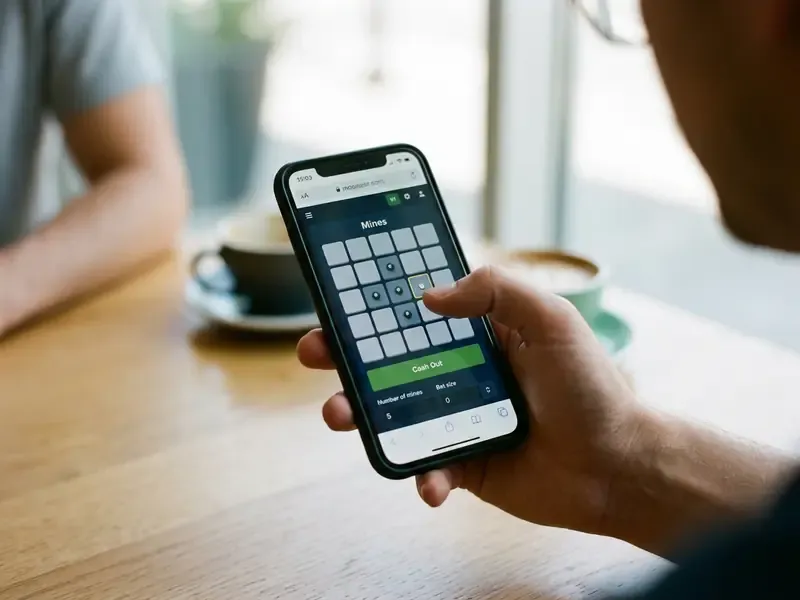
Mines online is a high-speed, wager-based instant casino game. You uncover safe tiles on a concealed grid, watch a payout multiplier climb, and try to cash out before you tap a hidden mine. The maths behind it is plain combinatorics, and the game hands you the controls: you set the board parameters yourself, trading potential reward against immediate risk.

Why does that matter to a reader in Australia? Because the same title can run at 94% RTP on one site and 99% on another, and because instant games are often the first thing excluded from bonus wagering. Details like that decide whether a session is entertainment or a slow leak.

Mines online is a high-speed, wager-based

Mines in 90 Seconds: The Short Version

  • Core loop:set a stake, choose how many mines are hidden on the grid, reveal safe tiles one by one, then cash out manually before a mine ends the round.
  • Grid options:the classic board is 5×5 (25 tiles), but provider versions run from 3×3 up to 9×9 and even 12×12, with mine counts configurable from 1 to 80 depending on the release.
  • Maths:the fair multiplier is the inverse of your cumulative survival probability, scaled down by the operator's RTP factor. More mines means fewer safe tiles, faster multiplier growth and steeper risk.
  • RTP range:roughly 94% (Hacksaw Gaming builds) up to 99% (house originals such as Stake Originals), with Spribe Mines commonly certified at about 97%.
  • Strategies:low-risk early cash-outs, high-mine volatility play, Martingale, Fibonacci, D'Alembert and the 1:1 Ratio approach. None of them change the negative expected value.
  • Fairness:Provably Fair (HMAC-SHA256 with Server Seed, Client Seed and Nonce) proves the board was locked before your first click. It does not remove the house edge.
  • Australia:interactive online casino games are prohibited under the Interactive Gambling Act 2001. Support: National Gambling Helpline, 1800 858 858.
Mines in 90 Seconds The Short

What Is the Mines Game and How Does It Work?

Mines is a fast instant-win iGaming title inspired by the old computer puzzle Minesweeper, rebuilt for online casino play with real-money wagers, variable multipliers and a voluntary cash-out button. Unlike a slot or a table game such as roulette or baccarat, every round of the Mines game puts one decision in your hands: bank what you have, or risk it on the next tile. Readers comparing platforms can review how we assess brands, licensing and payout friction across online casino products before committing funds.

Mines at a glance, key game metrics:

  • Maximum multiplier: up to 10,000x, depending on provider and grid size.
  • Average hit frequency: roughly 51% under a standard configuration (3 mines on a 5×5 board).
  • Stake range: about $0.10 to $100 per round, or the crypto and sweepstakes-token equivalent.
  • RTP band: 94.00% (Hacksaw Gaming builds) to 99.00% (Stake Originals house version).
  • Category: instant, crash-style round-based game with manual cash out.
  • Mobile support: full HTML5 support in iOS and Android browsers.
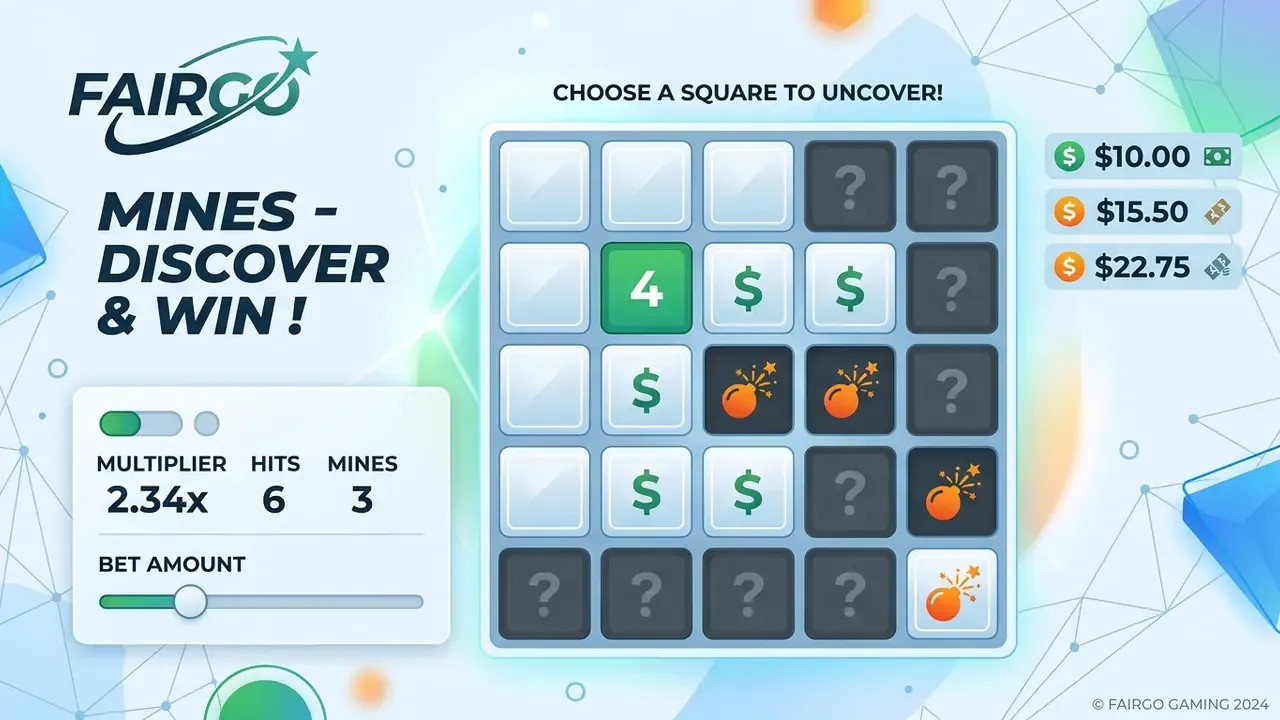
Mines interface map: grid, mine-count selector, live multiplier display and the Cash Out button
  • Type:Annotated game-board diagram
  • Description:Visual map of a 5×5 Mines board marking a safe tile (gem or star), a mine (bomb), already-revealed tiles, the stake input field and the cash-out control.
  • Purpose:Helps readers grasp the core mechanic of the Mines game before launching their first round.
  • Semantic mark-up rules:Image with alt text "mines game board layout". All labels and explanations duplicated as text in the DOM.
Fairgo heading-banner

Grid, Mines and Safe Tiles

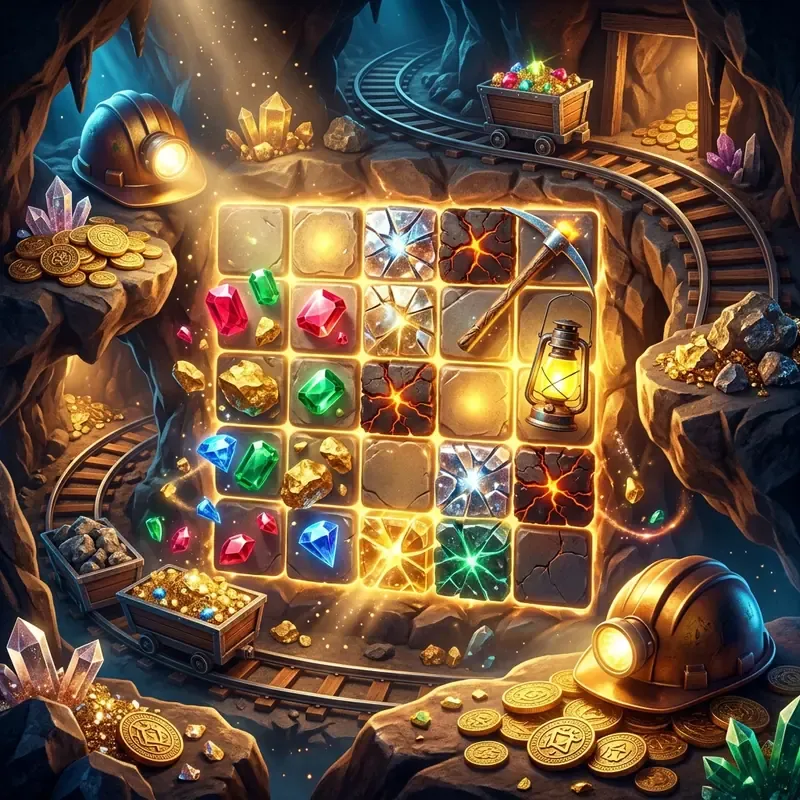
The standard Mines casino game opens on a 5×5 grid of 25 interactive tiles. Underneath sit a user-selected number of bombs and, in the remaining cells, safe gems. Before the round starts you pick anywhere from 1 to 24 hidden bombs ($M$), which leaves $25 - M$ safe tiles on the board.

Each successful pick opens a safe cell and nudges the round multiplier upward. Uncover a bomb and the round ends instantly: stake gone, uncollected multiplier gone with it. Here is the part players tend to underestimate. Every pick shrinks the pool of unopened tiles while the number of hidden bombs stays fixed, so the conditional risk climbs with each reveal. Formally, if $N$ tiles remain unopened and $M$ mines are still hidden, the chance of detonating on the next single pick is $M / N$, a value that rises mechanically with every safe click.

Grid, Mines and Safe Tiles. The

Grid Variations and Mine Counts (3×3 to 12×12)

The 5×5 board is the classic, but modern iGaming providers ship configurable field sizes:
  • Mini grids (3×3):9 tiles, maximum pace, typically 1 to 8 mines. Multipliers escalate very quickly because each pick removes a large share of the board.
  • Standard (5×5):25 tiles, the universal balance point, with 1 to 24 mines available.
  • Extended grids (7×7, 9×9, 12×12):up to 81 or even 144 tiles, with room for as many as 80 hidden mines. That configuration is typical of Hacksaw Gaming releases and Stake Originals-style house builds. The larger the field, the higher the theoretical top multiplier, reaching up to 10,000x the base stake.
Grid Variations and Mine Counts 3

Payout tables in these releases therefore depend on three variables at once: grid size, number of active mines, and completed safe picks. A 3×3 grid with 8 mines and a 9×9 grid with 80 mines both create near-binary, single-pick lottery conditions. A 9×9 board with two mines does the opposite: a long, slow multiplier ladder built from tiny increments.

How Winnings Are Calculated in Mines

Gross winnings in a Mines round equal the base stake ($B$) multiplied by the active cash-out multiplier ($K_s$) reached after $s$ safe reveals. In a mathematically fair model with zero house edge, the theoretical multiplier is the inverse of the cumulative survival probability of making $s$ consecutive safe picks:

$$\text{Fair Multiplier} = \frac{C(25, s)}{C(25 - M, s)}$$

Here $C(n, k)$ is the binomial coefficient $\binom{n}{k}$, $M$ is the number of hidden bombs, and $s$ is the count of revealed safe tiles. Commercial operators then apply a return-to-player (RTP) factor to that fair figure. In a title calibrated to 97% RTP, the advertised cash-out multiplier at each step is scaled to roughly $0.97 \times \text{Fair Multiplier}$. Individual rounds stay wildly variable; the long-run expected return stays pinned to the house edge.

A worked example makes the scaling explicit. With one mine ($M = 1$) and a single safe pick ($s = 1$), the fair multiplier is $C(25,1) / C(24,1) = 25/24 \approx 1.0417$x. Apply the 97% factor and you get roughly $0.97 \times 1.0417 \approx 1.01$x, which is the familiar 1.01x on screen in most commercial builds. On larger grids the same formula applies with $N$ replacing 25. That is why a 9×9 board holding 80 mines can advertise four-figure multipliers on one successful pick.

How Winnings Are Calculated in Mines

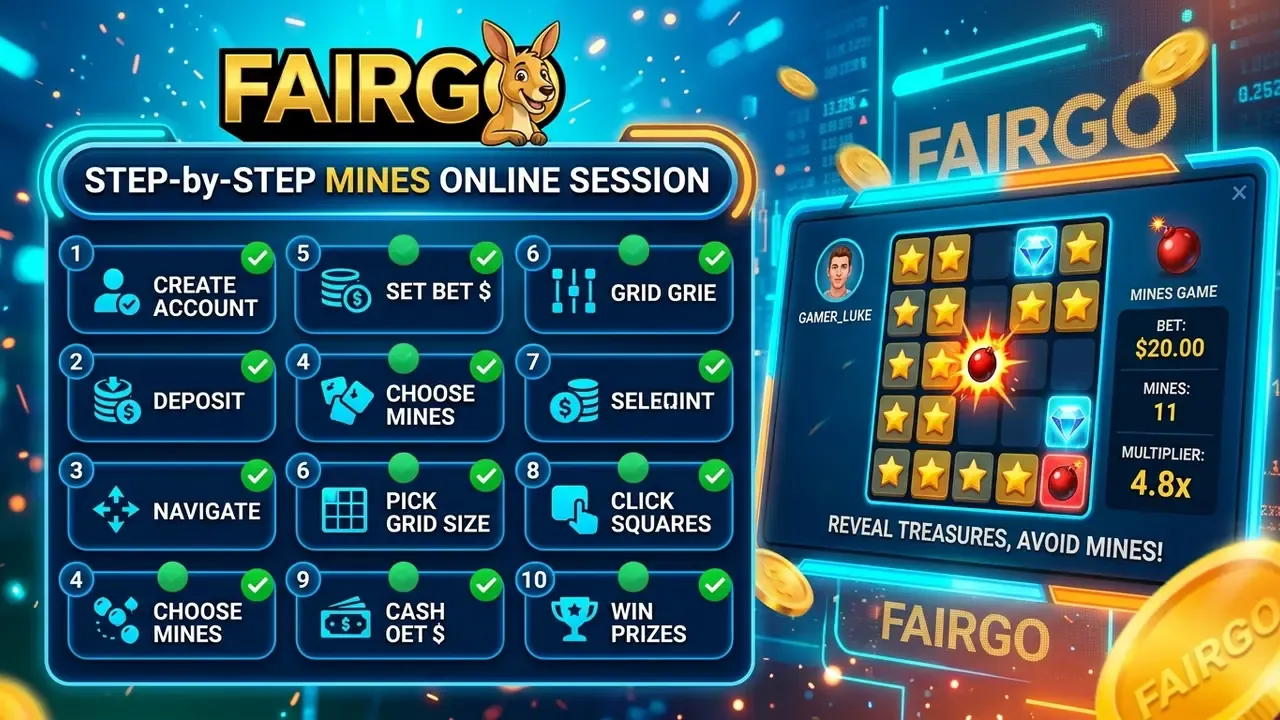
How to Play Mines Online: Step-by-Step

To play Mines online without fumbling, you need four moves: set a base wager, select the number of hidden mines, reveal safe tiles in sequence, then cash out manually before a mine appears. The round-based structure exists precisely so that risk exposure stays under your thumb in real time.

Five steps to running a controlled Mines online session
  • Type:Numbered checklist
  • Description:Action sequence: 1) set the base stake; 2) select the mine count (1 to 24 on a 5×5 board); 3) reveal tiles sequentially; 4) track the live multiplier; 5) press Cash Out to bank the win.
  • Purpose:Closes the practical intent "how to start playing Mines without mistakes".
  • Semantic mark-up rules:Render as a semantic ordered list; each step carries a short text explanation that remains readable without JavaScript.
Fairgo heading-banner
  1. Set the base stake. Enter the amount for the round within the table limits shown in the stake selector.
  2. Adjust the bomb count. Choose between 1 and 24 hidden mines to set the volatility of the board.
  3. Reveal grid tiles. Click cells one at a time, looking for the safe symbols.
  4. Monitor multiplier growth. The dynamic multiplier and the potential cash-out value recalculate after every safe click.
  5. Execute cash out. Press Cash Out to move accrued winnings into your balance before a mine ends the round.

Choosing Your Stake and Mine Count

The base bet and the bomb count between them dictate your financial exposure and the pace of multiplier growth in any play mines session. Low mine counts (1 to 3 bombs) give a high survival probability on the first pick, 24/25 or 96% with a single bomb, and correspondingly modest multiplier steps.

Crank the mine density up to 10 or 20 bombs and the picture inverts. Safe reveals become scarce, but the opening multiplier jumps sharply. Balancing those two dials is how players line the board up with their own bankroll management framework.

Two effects get conflated constantly, so let me separate them. Raising the stake size scales the absolute win and the absolute loss symmetrically, without touching a single probability. Raising the mine count leaves your money untouched but rewrites the odds of every subsequent click. Only the second lever moves volatility.

Risk and reward matrix: survival probability on a 5×5 board

Choosing Your Stake and Mine Count
Mines on boardSafe tiles1 safe pick2 safe picks in a row3 safe picks in a row5 safe picks in a row
1 mine2496.0%92.0%88.0%80.0%
3 mines2288.0%77.0%67.0%49.6%
5 mines2080.0%63.3%49.6%29.2%
10 mines1560.0%35.0%19.8%5.65%
15 mines1040.0%15.0%5.2%0.5%

Read the table as a volatility dial, not a strategy. Every drop down a column is compensated by a proportionally larger multiplier, so theoretical return stays tied to the game's RTP whichever row you pick.

When to Use Cash Out

Cash Out is the one operational lever that genuinely belongs to the player. It ends the round and transfers gross winnings to your balance. Because the game never forces you to clear the whole grid, you can stop after any safe tile.

Mathematically, cashing out early and chasing a deep streak carry the same expected value percentage, set by the title's RTP. What changes is variance. Early cash-outs produce frequent small returns and a smoother balance line; delayed cash-outs produce high volatility and fast drawdowns.

In optimal-stopping language, the rational threshold arrives when the expected value of continuing no longer beats the amount you can already bank: press Cash Out once $E[V_{t+1}] \le C_t$, where $C_t$ is the guaranteed sum on the table. Since the house edge is fixed, that inequality is effectively always satisfied in Mines. Which is why the practical advice is boring but sound: pre-commit a target number of picks before the round begins, instead of improvising mid-board while your pulse is up.

When to Use Cash Out. Cash

Auto Mode, Turbo Mode, the "Random" Button and Patterns

Modern Mines builds automate the repetitive parts. In Auto Mode you pre-select a pattern of tiles, fix a stake, and configure stopping rules based on loss limits or win targets. Most versions expose three parameters: number of auto-rounds, a stop-on-profit threshold, and a stop-on-loss threshold. Preset tile selections then let rounds repeat with no clicking at all.

Turbo Mode goes further, stripping out reveal animations and sound so rounds resolve almost instantly. Convenient, yes. But research from the Australian Institute of Family Studies (2024) notes that elevated event frequency in online gambling compresses decision time and makes disciplined bankroll tracking much harder.

Auto Mode, Turbo Mode, the Random

"High event frequency in online gambling compresses decision-making time and makes disciplined bankroll control substantially harder." (Australian Institute of Family Studies, 2024)

Updated for 2026: materials submitted to the Australian parliamentary inquiry into online gambling (2024) tie product structure, specifically high bet frequency and continuous availability, directly to harmful behaviour such as impulsive betting and loss chasing. Turbo Mode maximises both characteristics at once, which is why several operators now pair it with mandatory session-time reminders.

The "Random" function and strategic patterns. The Random (random pick) button lets the interface choose tiles for you. That removes behavioural bias and the odd attachment players form to a "lucky" corner cell. The alternative is a fixed pattern: a cross, a diagonal, a lap around the perimeter. Patterns speed up auto play and leave a cleaner record when you review your own session data. Neither approach carries any mathematical edge. Mine placement is randomised independently of your click order, so a pattern is housekeeping, not advantage.

Updated for 2026 materials submitted to

Mines Demo: How to Play Free Before Betting

Mines demo gives you a risk-free sandbox for testing mechanics, checking interface responsiveness and watching multiplier growth on simulated credits, with no deposit involved. Free-play versions are structurally identical to the live release and run on the same random number generation principles.

What Is Available in Mines Demo

In free mines demo mode you get the full set of grid controls: variable bomb selection, custom bet sizing with virtual funds, and the auto-play presets. It is the cheapest way to watch survival probability decay as consecutive safe tiles come off a 5×5 board.

Testing the mines free version also clarifies the difference between low-mine and high-mine setups, which a table alone rarely conveys. Virtual balances, though, cannot be transferred, converted or withdrawn. They exist to inspect functionality. Credits usually reset on page reload, and some demo builds switch off the Provably Fair verification panel because no wager hash is generated for fun-money rounds.

What Is Available in Mines Demo

How to Launch Mines Demo in Three Clicks

  1. Open the game page in a browser. Find Mines in the instant games or originals category of a casino lobby, or on the provider's own demo page. No account, email address or payment method is needed for fun-money play.
  2. Select "Demo", "Fun Play" or "Try for Free". The game loads with a virtual balance, commonly 1,000 units, instead of your real wallet, and the header shows a demo or fun-mode label.
  3. Configure and test. Set a virtual stake, choose a mine count, and run at least 50 rounds across three configurations (say 1 mine, 3 mines and 10 mines) to record how fast the multiplier climbs against how often rounds end early.

Treat the demo as an interface and volatility test, not a profitability test. A hot run in fun mode tells you nothing except that small samples wobble.

How to Launch Mines Demo in

Moving From Demo to Mines Real Money

Switching from free play to mines real money wagering changes the requirements, not the maths. Demo mode hands you endless virtual credits; real-money sessions demand bankroll discipline, compliance verification and an honest look at payment gateway friction. The psychological shift is the bigger one. In demo play each click tests a mechanic. With cash on the line, each click reduces finite capital, which switches on loss aversion and emotional arousal.

In an editorial review of offshore iGaming platforms accessible to Australian audiences, our team assessed payout transparency and terms across several casino brands hosting instant games (see our review framework at sitebname iGaming Guide). Testing registration flows and withdrawal conditions confirmed the obvious point that marketing tends to skip: practice-mode results never guarantee real-money outcomes, because cash wagers meet variance, account verification (KYC) and strict operator terms. That held true across every one of the iGaming platforms we looked at.

Moving From Demo to Mines Real

"Simulated gambling without real stakes normalises risk-taking and raises the likelihood of migration to monetary play." (You win some, you lose more, Australian parliamentary report, 2024)

Mines Strategies: Managing Stakes and Risk

No betting system alters the mathematical expectation or removes the house edge built into Mines casino games. What structured wagering can do is control volatility, impose decisions in advance and stretch bankroll longevity. Knowing the ceiling of each method is what stops unrealistic expectations forming. Every system below redistributes variance across a sequence of rounds. Not one converts a negative expected value into a positive one.

Low-Risk Strategy: Fewer Mines and Early Cash Out

The low-risk route sets the board with minimal hidden mines, typically 1 to 3 bombs on a 25-tile grid, and enforces a cash out after 1 to 3 safe reveals.

  • Mathematical profile: with 1 bomb, the chance of a safe first click is $24/25 = 96%$. Two safe tiles give a survival probability of $\frac{24}{25} \times \frac{23}{24} = \frac{23}{25} = 92%$.
  • Trade-offs: high hit frequency, frequent small payouts, low balance variance. The catch is that one unlucky bomb erases the accumulated profit of several winning rounds.

High Risk and Maximising Potential Payouts

High-risk play means heavy mine density (10 to 15 bombs) or long pick sequences of more than five clicks on a standard board.

  • Mathematical profile: with 10 bombs, the chance of uncovering 5 safe tiles in a row falls to:

$$\frac{15}{25} \times \frac{14}{24} \times \frac{13}{23} \times \frac{12}{22} \times \frac{11}{21} = \frac{3,003}{53,130} \approx 5.65%$$

  • Trade-offs: the multiplier scales exponentially to compensate for that 5.65% survival chance, yet long losing streaks are mathematically guaranteed. Hard loss limits are not optional here.

Generalised, the chance of surviving $k$ picks on an $N$-tile board holding $M$ mines is the hypergeometric expression $\binom{N-M}{k} / \binom{N}{k}$. On extended grids running 40 or more active mines, that value collapses within two or three picks, which is why high-density setups behave less like a skill game and more like a single-outcome lottery ticket.

High Risk and Maximising Potential Payouts

Martingale: Limits of the Strategy

Martingale is the classic progression: double the stake after every loss, aiming to recover prior losses plus one unit of profit on the first win.

RoundStake (units)Cumulative lossWin outcome (at 2.0x multiplier)Net profit
111Loss-1
223Loss-3
347Loss-7
4815Loss-15
51631Win ($16 \times 2 = 32$)+1

Applied to Mines, Martingale runs into hard walls. Exponential stake growth ($2^n$) hits the maximum table bet or drains the bankroll during an ordinary losing streak. On top of that, Mines multipliers shift with the number of picks, so maintaining a clean doubling progression demands fiddly recalculation that changes nothing about the negative expected value ($EV = (1 - \text{RTP}) \times \text{Stake}$).

The scale is easy to quantify. Ten consecutive losses require a cumulative outlay of $2^{11} - 1 = 1{,}023$ base units. Fifteen losses require 32,767. Either number breaches the table ceiling or your balance long before the sequence corrects itself.

Applied to Mines, Martingale runs into

"Progressive staking is loss chasing by definition: every doubled bet is motivated by the desire to recover, not by enjoyment of the game." (Supplementary submissions to the Australian parliamentary inquiry into online gambling, 2024, summarising Hing et al., 2021a)

The 1:1 Ratio Strategy (Minimum Volatility)

The 1:1 approach places exactly one mine on a 5×5 board, opens exactly one safe tile, and cashes out at once. Success probability on that click is $24/25 = 96%$, and the advertised return sits near 1.01x after the RTP adjustment.

Run it in auto mode and you get a long ribbon of micro-wins with barely any balance movement. The catch is arithmetic rather than emotional: roughly 4% of rounds lose the full stake while winning rounds return only about 1% of it, so the edge grinds steadily through the bankroll. It is a low-variance way of paying the same house edge, not a way of dodging it.

Fibonacci and D'Alembert Systems in Mines

Beyond Martingale, players reach for gentler progressions:
  • Fibonacci:stakes follow 1, 1, 2, 3, 5, 8, 13, 21 and so on. Step forward one place after a loss, back two after a win. It usually pairs with a fixed target multiplier of $\ge 2.0$x, which on a 5×5 board is roughly a 3-mine, 5-pick configuration. Growth is linear to moderate rather than exponential, so drawdowns build more slowly than under doubling.
  • D'Alembert:raise the stake by one unit after a loss, drop it by one after a win. This flattens the curve substantially and materially reduces the risk of wiping the bankroll compared with Martingale, at the price of much slower recovery.
  • Anti-Martingale (Paroli):stakes rise only during winning streaks and reset after a loss, capping downside but leaving results dependent on short lucky runs.
Fibonacci and D'Alembert Systems in Mines

All three shuffle risk across time. None touches the fixed edge baked into the multiplier ladder.

Who Should Skip This Game

Mines suits some players and actively harms others. Saying so plainly is more useful than another tips list:

  • Anyone who has chased losses across previous sessions. Sub-second rounds in Turbo Mode remove the natural pause that slower games provide.
  • Players clearing a welcome bonus, since instant games frequently contribute 0% to 5% toward wagering requirements (more on that below).
  • Anyone relying on "predictor" software, Telegram signal groups or paid patterns. Without exception, these do nothing against a certified RNG or a Provably Fair hash chain.
  • Players in jurisdictions where interactive online casino games are prohibited, Australia included, under the Interactive Gambling Act 2001.
  • Anyone gambling with money earmarked for rent, bills, credit repayments or savings.
Who Should Skip This Game. Mines

Mines Real Money: Operator Checks, Deposits and Choosing a Casino

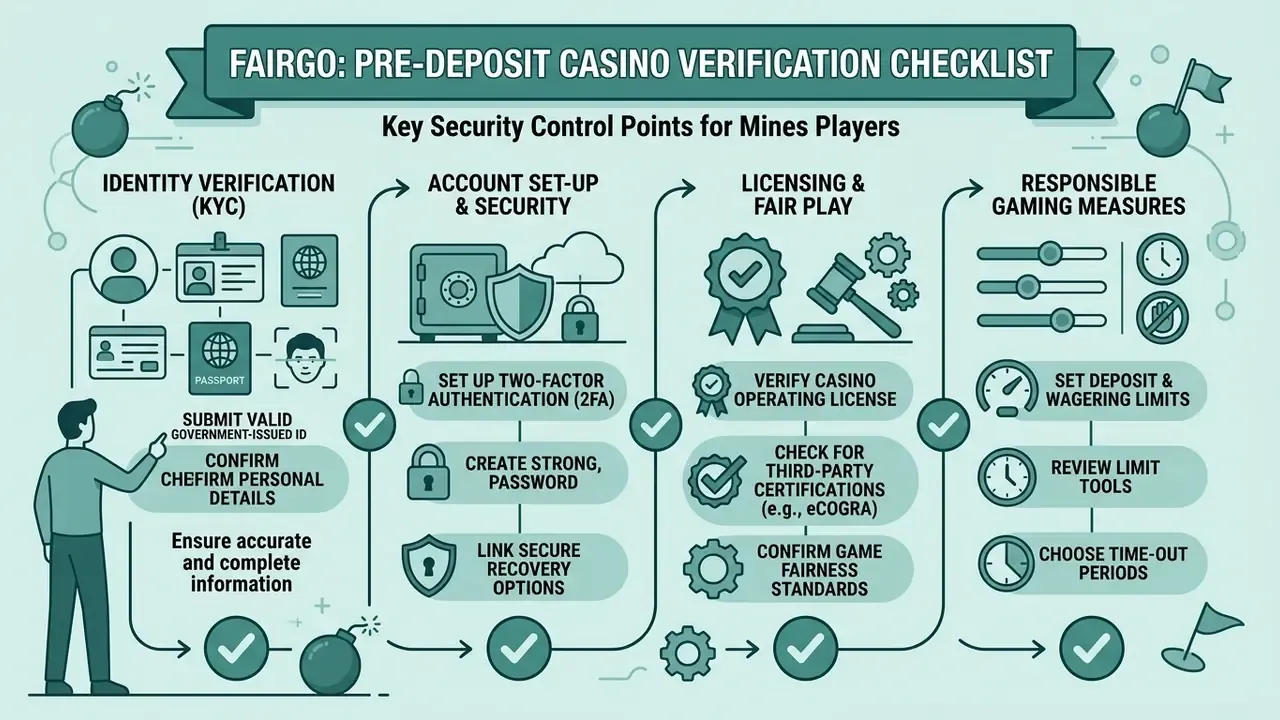
Before you deposit to play Mines real money rounds, verify the boring technical and legal basics: TLS encryption, valid licensing credentials, transparent withdrawal limits and audited fairness systems. A terms-first approach reduces counterparty risk, which in offshore iGaming is the risk that actually costs people money. Choosing a reputable Mines casino means auditing operator licensing, provider credentials, withdrawal processing speed and the fine print stapled to the welcome promotion. Check the bonus terms before registration, and promotional claims either translate into playable value or they do not.

Mines Real Money Operator Checks, Deposits

"Problem gambling is roughly three times more prevalent among people who gamble online than among those who gamble solely on land-based forms." (Hing et al., 2021a, summarised in supplementary submissions to the Australian parliamentary inquiry into online gambling)

mines real money casino security checklist
Four mandatory checks before real-money play: Licence, SSL/TLS, RTP, Cashier and KYC
Verification criteriaIndustry standard requirementRed flags and warning signsEditorial assessment note
Licensing and statusCuracao, MGA or another recognised jurisdiction; licence number, issuing regulator and validity period all visibleUnlicensed, missing regulator seal, hidden ownership dataMandatory check before registration
Provably Fair supportIn-game verifier with seed access (HMAC-SHA256)Claims of "fairness" with no seed or nonce disclosureEssential for independent board auditing
RTP transparencyClearly displayed in game info (94% to 99%, by provider)Hidden RTP submenus, undisclosed low RTP tiersAvoid sites offering sub-96% versions without disclosure
Bonus wageringReasonable multiplier, for example 30x to 35x bonusAbove 50x wagering, expiry under 3 days, 0% game weightingRead the fine print on Mines wagering contribution
Payout mechanicsFast crypto or e-wallet processing, transparent KYC, published withdrawal capsUnclear caps, delayed manual checksTest the path with a small deposit and withdrawal first
EncryptionHTTPS with a valid certificate, TLS 1.2 minimum, TLS 1.3 preferredMixed content warnings, expired certificatesVerify before entering payment or ID data
Support quality24/7 live chat with a measurable response timeEmail only, no published hoursSend a test enquiry pre-deposit

Stake, Deposit and Risk Control

This information is general in nature and does not replace advice from a qualified professional. Gambling carries financial risk. If gambling stops being entertainment, contact the National Gambling Helpline on 1800 858 858.

Effective real-money play starts with exposure limits set before any transfer lands in a casino account. Widely cited risk-management guidance caps a single Mines bet at 1% to 2% of the session bankroll, with 5% or more generally treated as aggressive. Note: that range reflects common industry and harm-minimisation guidance rather than one named regulatory standard, and firmer sourced data would strengthen the figure.

Put numbers on it. With a $500 starting deposit, an individual bet should sit between $5 and $10. Conservative sizing is what keeps a bad streak survivable, and bad streaks are statistically routine in high-volatility crash and instant games.

Effective real-money play starts with exposure

"65.1% of Australian adults participated in at least one form of gambling in the previous 12 months." (National Gambling Prevalence Study Pilot, 2024, Australian Gambling Research Centre, AIFS)

Alongside stake sizing, set three hard limits before the first round: a weekly deposit cap, a session stop-loss, and a clock. Instant games resolving in under a second can pack hundreds of wagering decisions into a few minutes, so the time limit matters as much as the money one.

RTP and Provably Fair in Mines

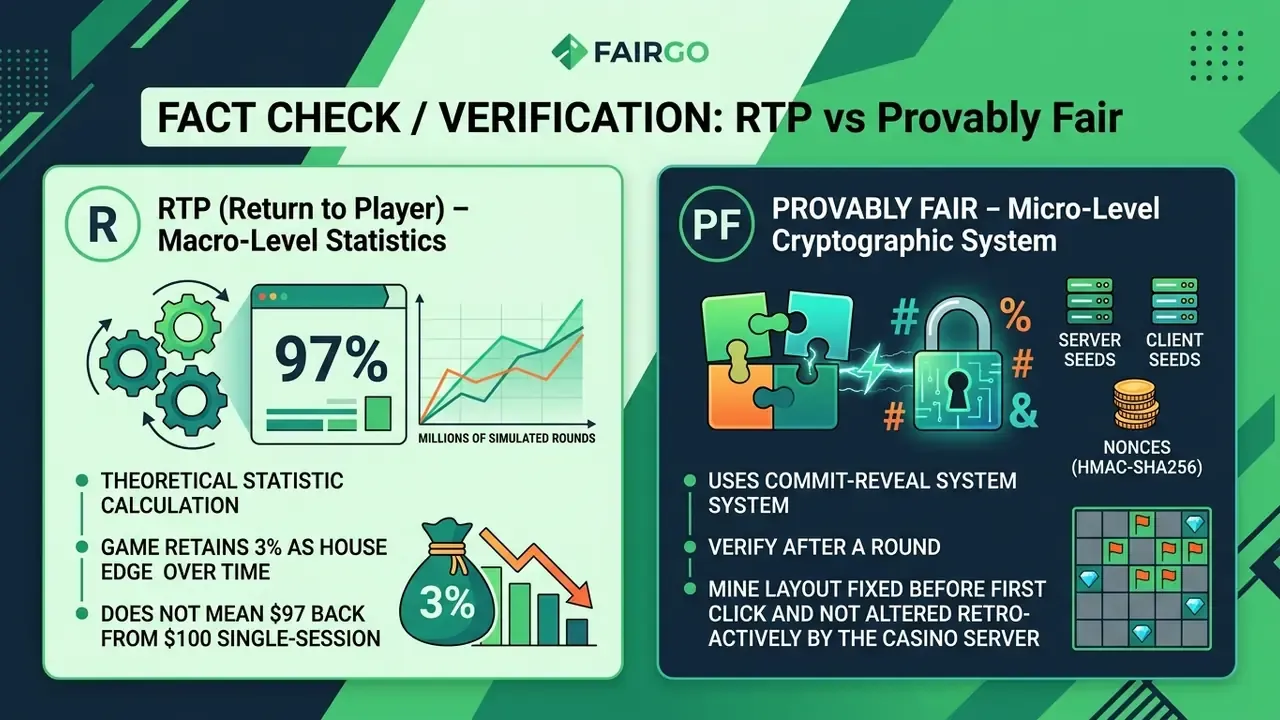
RTP and Provably Fair verification are the two technical pillars of transparency in modern Mines titles. RTP is the long-term statistical payback programmed into the paytable, running from 94% (Hacksaw Gaming builds) and 96% (SmartSoft) through 97% (Spribe) up to 99% on proprietary house originals such as Stake Originals or BC.Game. Note: confirm provider RTP in the game's own info panel at your chosen operator, because operators sometimes licence several RTP tiers of the same title.

[💬 QUOTE: "Provably Fair algorithms guarantee that outcome generation was locked before the round began and was not altered post-bet. However, cryptographic fairness only proves random generation. It does not remove the built-in house edge or guarantee a positive financial return." (iGaming Compliance Review)]
RTP and Provably Fair in Mines

"Cryptographic fairness proves randomness of generation but does not remove the built-in house advantage; expected return is determined solely by RTP." (Independent iGaming RTP audit analysis, 2024)

This information is general in nature and does not replace professional advice. RTP is a statistical measure calculated across millions of rounds; individual session results can differ substantially.

How to verify a Provably Fair Mines round, a practical checklist:

  1. Before betting, open the Fairness or Provably Fair panel and copy the hashed server seed shown for the current seed pair. That is the casino's pre-commitment.
  2. Set or record your client seed. Most platforms let you replace the auto-generated string with your own. Do it, because a player-supplied seed removes any argument that the operator controlled both inputs.
  3. Note the nonce, which increments by one with every round played on that seed pair.
  4. Play your rounds as normal.
  5. Rotate the seed pair. Rotation reveals the unhashed server seed for the completed pair.
  6. Hash the revealed server seed with SHA-256 and check it matches the hash from step 1. Then recompute the round outcome from the HMAC-SHA256 chain of server seed, client seed and nonce, using the platform's verifier or any third-party calculator.

If any of those six elements is missing from the interface, the site is describing fairness rather than demonstrating it.

How to verify a Provably Fair

Mines Provider Comparison: Spribe, Hacksaw, BGaming and House Originals

Provider / titleRTPGrid sizeMine rangeDistinctive feature
Spribe (Mines)97.00%5×51 to 20"Random" button, auto mode, in-game chat, wide stake bands
Hacksaw Gaming (Mines)94.00% to 96.50%3×3, 5×5, 7×7, 9×91 to 80Fully configurable grid, very high volatility, up to 10,000x
BGaming (Minesweeper XY)98.40%5×2, 5×3, 5×4, 5×5, 5×61 per rowRow-by-row progression, classic ladder format
Stake Originals (Mines)99.00%5×51 to 241% house edge, custom auto-bet scripts, provably fair verifier
SmartSoft (Mines-style instant)about 96.00%5×51 to 24Tournament integration, jackpot layers
Coins.Game (Mines Jet)Operator-published5×51 to 24Weekly tournaments, jet-themed multiplier ladder

Two practical takeaways sit inside that table. First, one game name can carry a five-percentage-point RTP spread depending on who built it, so check the info panel rather than the brand. Second, higher RTP does not mean lower volatility. A 99% house original with 20 mines active will empty a balance faster than a 94% build played at one mine.

Bonuses, Promotions and Offer Terms

Welcome bonuses lead with headline match percentages, "100% up to $500" and similar. Real utility, though, lives in the wagering conditions, game weighting and maximum cash-out caps.

Plenty of online casino operators cut the wagering contribution of instant games such as Mines to 5% or 0%. In plain terms: your Mines wagers may not move the playthrough counter at all. Read the terms and confirm that instant or crash titles are eligible before claiming promotional funds. Some operators also cap the maximum stake allowed while a bonus is active, and a single oversized Mines round can void the whole bonus balance. That is a bad way to learn the rule.

Bonuses, Promotions and Offer Terms. Welcome

"Australian research consistently links bonuses and free bets with loss chasing, impulsive betting and selection of longer-odds wagers." (Supplementary submissions to the Australian parliamentary inquiry into online gambling, 2024)

Site Selection Criteria for Mines, Payments and Withdrawal Speed

When comparing iGaming platforms that host Mines, prioritise site security, operational reputation and support availability. A verified site runs valid SSL/TLS encryption, states deposit and withdrawal fees plainly, and answers on live chat around the clock. Independent player complaint databases fill in the rest, particularly on payout reliability and verification friction.

For most readers the payment layer creates more friction than the game itself. Use the framework below to build your own comparison instead of trusting a headline rating:

Comparison fieldWhat to verifyWhy it matters for Mines specifically
Provider version hostedSpribe, Hacksaw, BGaming or an in-house originalDetermines RTP (94% to 99%), grid options and mine range
Deposit methodsCrypto (BTC, ETH, USDT, LTC), cards, vouchers such as Neosurf, bank transfer or PayID where offeredInstant games invite long sessions; slow rails encourage over-depositing
Withdrawal speedPublished processing window: crypto usually minutes to hours, cards and bank transfers 1 to 5 business daysFast round cycles make prompt withdrawal the main protection against re-wagering profits
KYC timingWhether ID verification happens at signup or at first withdrawalLate KYC is the most common cause of delayed payouts
Instant-game wagering weightContribution of Mines toward bonus playthrough, often 0% to 5%Determines whether a bonus is usable at all
Demo availabilityWhether Mines launches in fun mode without registrationLets you test the interface before any deposit
Limit toolsDeposit caps, loss limits, session timers, self-exclusionEssential in a game with sub-second round resolution

International listings often attach Mines coverage to brands such as Stake, BC.Game, Coins.Game, Shuffle, Betsson and Pin-Up, among others. Availability, licensing and legality vary sharply by jurisdiction. Australian readers should weigh the legal position set out in the disclaimers on this page before pursuing any of them, and should always run one small test deposit and withdrawal before scaling stakes.

Mines Mobile and Mines Download: Playing on Your Phone

Mines mobile play works across iOS and Android phones and tablets, either through the mobile browser or a downloadable app. HTML5 does the heavy lifting: graphics, touch controls and the cryptographic verification tools all adapt to smaller viewports automatically.

Playing Mines Through a Mobile Browser

Browser play skips installation entirely, running in Safari, Chrome or Firefox. The HTML5 build keeps full functionality: touch-optimised tile opening, quick bet sliders, live multiplier readouts and seed verification panels, with no meaningful loss of speed.

"The portability of mobile devices enables gambling across a far wider range of contexts, at home, at work, in transit, blurring the boundary between gambling and everyday life." (National Gambling Prevalence Study Pilot, 2024, Australian Gambling Research Centre, AIFS)

That convenience is exactly why mobile sessions deserve tighter limits than desktop ones. Switch on deposit caps and session reminders inside account settings rather than trusting yourself to watch the clock. Self-monitoring on a phone, five minutes at a time, rarely holds.

When Is a Mines Download Available?

Some casino platforms distribute standalone packages: Android APK files, or Progressive Web Apps for desktop and iOS.
  • PWA (Progressive Web App):creates a lightweight shortcut on the home screen for single-tap access, with no app store approval needed. Because a PWA runs inside the browser sandbox, it requires no special installation permissions.
  • APK downloads:need manual installation on Android ("Install from Unknown Sources"). Download strictly from official operator domains to avoid phishing packages or modified code. Verify the publisher, check the file signature where possible, and never grant an APK access to SMS, contacts or accessibility services.
  • iOS:Apple ships native apps only through the App Store. Any site offering a direct "Mines app for iPhone" outside it is serving either a PWA shortcut or an unverified configuration profile, and the latter is a security risk.
When Is a Mines Download Available

There is no standalone, officially published "Mines game app" independent of casino platforms. Every legitimate build arrives either inside an operator's app or through the mobile web client.

FAQ About the Mines Game

Responsible Gambling and Editorial Notice

This article is informational and general in nature. It is not financial, legal or clinical advice, and it does not promise or imply any financial return. Gambling involves the risk of losing money, and no strategy described here removes the operator's mathematical advantage. Interactive online casino games are prohibited under the Australian Interactive Gambling Act 2001, and offshore operators fall outside domestic regulatory protection. Players must be 18+, or 21+ in some jurisdictions. Free, confidential support is available 24/7 in Australia via the National Gambling Helpline on 1800 858 858 or at gamblinghelponline.org.au.

Responsible Gambling and Editorial Notice. This